Hello! I’m Stephen Smith, a Team Lead and React Developer working in the DC Area. Ever since I attended RIT, I found I enjoyed making snappy, functional web pages and I’m glad I’ve been able to be in the industry since then. In my years since, I’ve picked up a few additional hats, including that of a Team Lead at my current company.
If you want to check out what I work on, I have a selection below. For everything else, check the navigation at the top.
Professional Projects
All of the following were made as part of my day job for the United States Agency for International Development (USAID). Each of the websites was made using JavaScript with React.js, Ruby on Rails, and an Oracle database.
FAE Agency Details Page (Jan 2018)
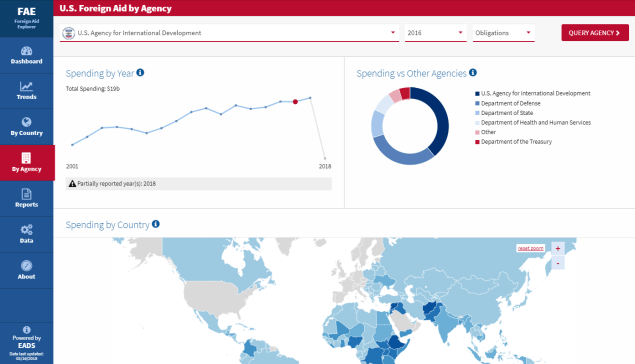 When the United States government gives foreign aid, it is commonly implemented through various agencies, such as USAID or the Department of State. This dashboard is made as part of the Foreign Aid Explorer (FAE) to show how the agencies use that money: how much they give, where it goes, and what it gets used for.
This is the most recent (released) project that I led, from the initial design to development to release. In addition to managing tasks and communicating status to our clients, I also handled several development tasks, focus on improving the user experience.
Primary Accomplishments
- Users can save their agency/year/measure selection as a distinct link.
- This being a single page app, pressing the browser’s back button takes the user to their previous selection instead of exiting the page entirely.
- Users can change multiple options in their selection without the page refreshing after the first selection
Dollars to Results (Aug 2017)
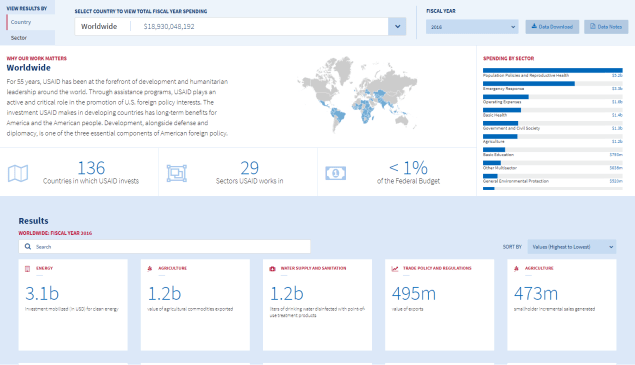
Where the Foreign Aid Explorer answers the question of “how do we spend our aid?” this page instead seeks to answer the question of “why do we give aid?” which is a question that, especially recently, comes up frequently.
This is the first major project that I led, starting from the development phase through completion. We had a strict deadline of 4 weeks to deliver, but our team managed complete the project with ample time to collect and act on feedback. As above, I both managed the project and participated in development.
Primary Accomplishments
- Wrote the initial data API and website structure, which is still in use today.
- Users can search without knowing exactly what they’re looking for: searching for “clean water” will return “1.2b liters of drinking water disinfected”
- The website caches data so that the user never needs to wait for database operations to finish.
IDEA Country Dashboard (Sept 2016)


The Country Dashboard is one of our more comprehensive pages that showcase a wide range of statistics about a country. As part of the International Data & Economic Analysis (IDEA) project, anyone can look at various statistics about literacy rates or GDP for a country, and see how it compares to similar countries.
This is one of the earlier projects I worked on before I began leading them. It’s still in heavy use today, accounting for about half the traffic to all of IDEA.
Primary Accomplishments
- Users can see stats about a country, including population and languages under the Quick Look section.
- Data Analysts can use the table in the Sector Detail page (second image) to drill down and see current stats about the country, as well as how it’s changed over time.
- Created the initial structure and data API for this page.
Personal Project
Currently, I only have one personal project worth showing, but I will link any future projects that are publicly hosted below.
RPG Spell Card Generator (In Development)

There is a tabletop RPG, Triten, that I play that has a lot of different spells players can learn. Given that it’s new and made by a small number of people, no resources have yet been put into accessories. So, because none of my players can remember what their spells do and looking it up in the book is slow, I thought to make this generator so I can have quick information about spells available for everyone.
This is made with JavaScript/React and hosted publicly on GitHub (link in title). As the project is ongoing, there are still features I would like to include in the future, but it is able to be used by anyone with the sourcebook PDF.
Primary Accomplishments
- Users can save data locally or copy the data as JSON to send to another person.
- The spell cards can be printed, hiding any element irrelevant to print.
 Always More Hats